On this page
Key facts
- Typical Kei Truck grades
- 3 to 4, with 3.5 the most common (estimate)
- Interior grades
- A (best) to D, with E at some auctions
- Codes to read first
- S (rust) and C (corrosion)
- Number after a code
- Size or severity, usually 1 to 3
- Mileage
- Recorded in kilometers; marks flag doubtful readings
- Repair history
- Overall grade R, or RA for minor structural repairs
In Japan, the bulk of the used-vehicle trade runs through auctions open only to licensed dealers. Before each sale, an inspector employed by the auction walks around the vehicle, grades it and marks every flaw on a standard form. That form is the auction sheet, and when you import a Kei Truck it is often the nearest thing you get to seeing the truck yourself.
Each auction prints its own layout, and a few codes vary. What follows is the shared core. When a sheet shows something you don't recognize, ask your agent to translate it word for word.
What is an auction sheet, and who writes it?
The inspector works for the auction, not the seller. The sheet carries an overall grade, an interior letter, the odometer reading, the main equipment, a body diagram covered in damage codes and a box of handwritten notes.
It is a body and cosmetics report, not a mechanical one. Nobody strips the engine, lifts the truck or takes it for a fast drive. A strong grade says the body is honest. It says nothing about when the timing belt was changed, which is why our maintenance guide assumes it is due.
Insist on an image of the original sheet rather than a retyped summary. Exporters and auction agents can normally supply one.
What do auction sheet grades mean?
Overall grades run from S at the top down to 1, with R or RA marking repair history. The grade sits in a box near the top, and cutoffs shift slightly from auction to auction, so read this as common practice rather than a rulebook.
| Grade | Usual meaning | Buy it as a 25-year Kei Truck? |
|---|---|---|
| S | New or nearly new | Suspicious. No truck this old should get it. |
| 6 | Like new, at auctions that use it | Suspicious, for the same reason |
| 5 | Excellent, with very low mileage for its age | Rarely seen; check the paperwork twice |
| 4.5 | Excellent apart from tiny marks | Yes, if the price is right |
| 4 | Good, with light cosmetic wear | Yes |
| 3.5 | Average, with scratches and small dents | Yes, if the underbody codes are clean |
| 3 | Below average, with work needed | Only after reading every code |
| 2 | Poor, with heavy rust, holes or big faults | Project or parts only |
| 1 | Used by some auctions for flood, fire or heavily modified vehicles | No |
| R or RA | Repairs to the body structure; RA means minor | Rarely worth it |
| 0, or a row of asterisks | Left ungraded at some auctions | No, unless the notes explain why |
An R has nothing to do with a replaced fender. In Japanese auction practice, repair history means work on the structure itself, such as frame members or pillars. Structural repairs can be done well, and on a costly car the savings might justify checking. A Kei Truck is cheap enough that a repaired one rarely saves you enough to be worth the doubt.
What do the interior grades mean?
Interior grades run from A, close to new, down to D, or E at some auctions. The letter usually sits beside the overall grade:
- A: very clean, close to new
- B: clean, with light wear
- C: worn, with stains, small burns or tears
- D: dirty, torn or smelly
- E: very poor, at auctions that use it
The two often appear together. In 4B, the 4 rates the body and the B rates the cab. In 3.5C, an average body comes with a cab that has seen hard use. A C cab on a farm truck is normal and cheap to put right, because new seat covers and mats take care of most of it. A smell the inspector bothered to write down is harder to cure.
What do the letters and numbers on the damage map mean?
Each flaw gets a letter for the kind of damage and a number, usually 1 (small) to 3 (large), for its size or severity. The marks sit on a bird's-eye drawing of the truck, and some auctions run the scale higher.
| Code | Meaning | Deal-breaker? |
|---|---|---|
| A | Scratch, A1 small to A3 large | No. Working trucks collect them. |
| U | Dent, U1 to U3 | Not on the bed or tailgate. Look closer at cab dents. |
| B | Dent with a scratch | Same as U, plus a paint touch-up |
| W | Wavy panel or old filler, W1 faint to W3 obvious | Only if it sits near the frame. Ask what happened. |
| S | Rust, S1 light and S2 heavy | Depends on where. Bed lip, no. Frame rail, yes. |
| C | Corrosion that has eaten into metal, C1 or C2 | Yes, anywhere on the frame or underbody |
| P | Paint fault, such as marks or peeling | No |
| X | Panel that needs replacing | No, but price in a part and labor |
| XX | Panel already replaced | One is fine. Several suggest a past impact. |
| Y | Hole or crack, Y1 to Y3 | Check for rust behind it on a floor or bed |
| G | Stone chip in the windshield | No, unless it has spread into a crack |
Start with the rust codes. Scratches are cheap and honest, while corrosion is structural and keeps spreading. Pick the scruffy truck with a clean underside over the glossy one with C marks near the frame. Panels marked X or XX mean body parts or a body shop are in your future.
Where do you find the year, mileage and chassis number?
The top block of the sheet holds the vehicle details. These are the fields worth finding:
- Year. Usually the year of first registration, often in Japanese era form. For Heisei years, add 1988, so H11 is 1999 and H13 is 2001. Showa years run up to 1989; add 1925 to those.
- Model code and chassis number. The model code (型式) and chassis number (車台番号) identify the truck. Some sheets mask part of the chassis number. Whatever is shown must match the export certificate.
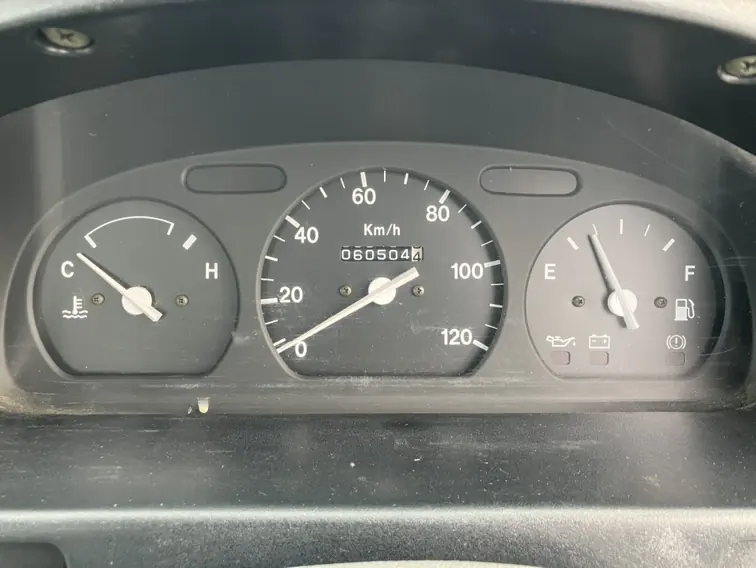
- Mileage (走行). Recorded in kilometers, so multiply by 0.62 for miles. A symbol or note beside the reading means the inspector doubts it.
- Transmission and equipment. F5 means a five-speed manual with a floor shifter, and AT means automatic. AC, PS and PW stand for air conditioning, power steering and power windows. If a listing promises 4WD, find it on the sheet too.
The sheet's year is not the build month. For import timing, see our 25-year rule guide.
What do the inspector's notes say?
The codes describe the body, and the free-text notes describe the machine. These words are worth knowing on sight:
| Japanese | Reading | Meaning |
|---|---|---|
| 下回り錆 | shitamawari sabi | Underbody rust |
| 腐食 | fushoku | Corrosion |
| 穴 | ana | Hole |
| 修復歴 | shūfuku-reki | Structural repair history |
| エンジン異音 | enjin ion | Engine noise |
| 白煙 | hakuen | White smoke |
| オイル漏れ | oiru more | Oil leak |
| 冠水 | kansui | Flood damage |
| 走行不明 | sōkō fumei | Mileage unknown |
| メーター交換 | mētā kōkan | Meter replaced |
| デフロック | defu rokku | Diff lock |
Ask for every note translated in full. "Some minor issues" is a summary, not a translation.
How do Kei Trucks usually grade?
Most Kei Trucks old enough to import grade between 3 and 4, and 3.5 is the most common (estimate). They were built to work, so A and U marks on the bed are normal, and cabs usually land at B or C.
Grade 4 and up exists, and the price shows it. The sweet spot is usually a 3.5 whose underbody codes are clean. Studless winter tires (スタッドレス) on the sheet point to snow country, where road salt makes the rust codes worth a second look. Each model has its own rust-prone spots, covered in our model guides.
What are the red flags on a Kei Truck auction sheet?
- Any C on the frame or underbody, or S2 close to the frame rails
- R or RA with notes about the frame or floor
- A mileage symbol, 走行不明 or メーター交換
- 冠水, or notes about water inside the cab
- Notes about smoke, engine noise or 4WD that won't engage
- A chassis number that doesn't match the export certificate
- A grade of S, 6 or 5 on a truck this old
- A sheet that is retyped, cropped or "not available"
- A chassis number that keeps reappearing in auction listings over a few weeks
Once these are familiar, every listing gets easier to judge, whether it is an auction lot, an exporter's stock or a US seller's recent import. Next, see how to import a Kei Truck, our buying checklist and the Kei Truck cost guide.
Frequently asked questions
Which auction grade should I look for on a Kei Truck?
For a truck old enough to import, a 3.5 whose underbody codes are clean is usually the sweet spot. Grade 4 and up exists but costs more. A grade 3 can still be fine when every mark on the diagram is cosmetic. Whatever the number, pass on any corrosion code near the frame or underbody.
What does R mean on a Japanese auction sheet?
R means the vehicle has had repairs to its body structure, such as frame members or pillars, and RA marks lighter structural work. A bolted-on replacement panel alone doesn't earn an R. Because Kei Trucks are cheap, the savings on an R truck seldom make up for the uncertainty unless photos show exactly what was fixed.
What does 3.5B mean on an auction sheet?
The number is the overall body grade and the letter is the interior grade. In 3.5B, the 3.5 says the body is average, with visible scratches or small dents, and the B says the cab is clean apart from light wear. For a Kei Truck that earned its keep on a farm, that is a normal, healthy result.
Can a Japanese auction sheet be faked?
The sheet is issued by the auction, but the copy that reaches you can be retyped, cropped or summarized. Ask for an image of the original, have the notes translated word for word, and match the chassis number to the export certificate. If an auction truck's seller has no sheet to show, assume it says something they'd rather you didn't see.
Does the auction sheet show the build date?
Usually not. The year field is normally the first-registration year, often written as a Japanese era year such as H13 for 2001. The build month comes earlier and has to be confirmed from the truck, its chassis number or maker records. The 25-year import rule runs on the build date, so don't rely on the sheet's year.
Should I buy a Kei Truck that has no auction sheet?
Not every truck went through an auction, so a missing sheet isn't fatal on its own. Replace it with something just as detailed: underside photos, a cold-start video, close-ups of the usual rust spots and the chassis number. If the truck did sell at auction and the seller won't share the sheet, walk away.