On this page
Key facts
- Maker
- Suzuki Motor Corporation
- Years sold in Japan
- 1961 to today (current DA16T since September 2013)
- US-importable now (as of Oct 2026)
- Trucks built October 2001 or earlier: all DC51T/DD51T and DA52T/DB52T, plus the earliest DA62T
- Chassis codes
- DC51T/DD51T (1991-1999), DA52T/DB52T (1999-2001), DA62T (2001-2002), DA63T (2002-2013), DA65T (2005-2013), DA16T (2013 on)
- Engine(s)
- F6A 657 cc 3-cylinder SOHC with timing belt (1990-2001); K6A 658 cc DOHC with timing chain (2001-2013); R06A (2013 on)
- Layout and drive
- Engine under the cab; rear-wheel drive or part-time 4WD
- 4WD system
- Part-time 4WD; 1990s trucks used an extra-low gear or a high/low transfer, 1999-2001 4WD manuals a high/low transfer
- Rated load (Japan)
- 350 kg (about 770 lb)
- Rebadged as
- Autozam Scrum and Mazda Scrum (from 1989); Nissan NT100 Clipper and Mitsubishi Minicab on the current DA16T
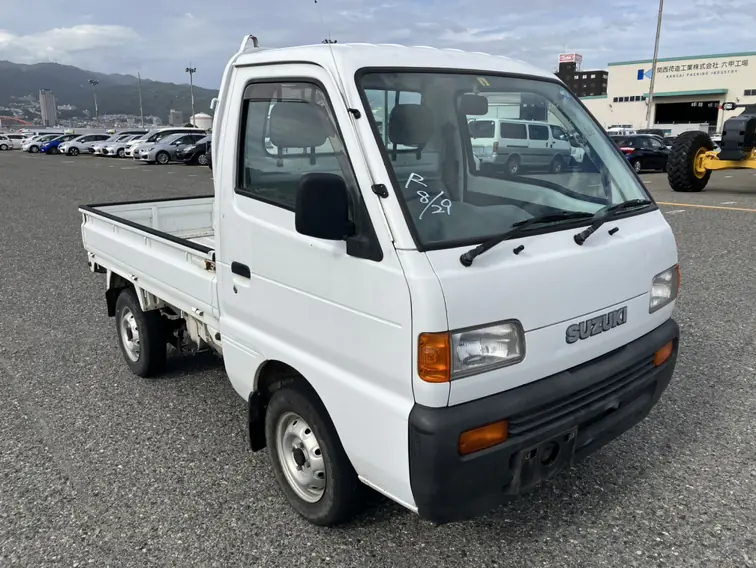
The Suzuki Carry is often the first Kei Truck a US buyer shortlists: it was built in large numbers, it is simple to work on, and parts for the 1990s trucks are easy to find.
What is the Suzuki Carry?
The Suzuki Carry is a two-seat cab-over Kei Truck that Suzuki has built since 1961. The engine sits under the cab and drives the rear wheels, or all four on 4WD versions. It is sized to Japan's Kei class, the small-vehicle category that caps engines at 660 cc, and rated to carry 350 kg (about 770 lb) in the bed.
Most Carry trucks in the US run the F6A, a 657 cc three-cylinder. Suzuki's 1991 specification sheet rates the carbureted version at 42 PS (metric horsepower, about 41 hp) and pairs it with a 4-speed or 5-speed manual and a leaf-sprung rear axle. It is basic hardware, and that is the appeal: most jobs need hand tools and a service manual, not a dealer.
The Mazda Scrum is a Carry
Mazda sold the same truck as the Scrum, first under its Autozam brand from 1989 to 1995 and then as a Mazda. Scrum trucks carry Mazda chassis codes, such as DK51T on a 1990s 4WD truck or DG52T and DH52T on 1999-2001 trucks. The engine, gearbox and most service parts are Carry parts, so search both names when you shop and give your parts supplier the matching Carry code.
The later rebadges are too new to import. Since December 2013 the Nissan NT100 Clipper has been a Carry, and since February 2014 so has the Mitsubishi Minicab truck, both built on the current DA16T.
Which Suzuki Carry generations can you import?
As of October 2026, a Carry can enter the US under the 25-year rule, the federal exemption from US safety standards for vehicles at least 25 years old, if it was manufactured in October 2001 or earlier. The clock runs from the month of manufacture, not the model year or the date of first registration in Japan. The 25-year rule guide shows how to confirm the build month.
| Generation | Years | Chassis codes | Engine | Notes | US-importable (Oct 2026)? |
|---|---|---|---|---|---|
| 8th gen | 1985-1991 | DA71T (2WD), DB71T (4WD) on 550 cc trucks | 550 cc F5B, then 657 cc F6A from March 1990 | Rear diff lock on some 4WD trucks from 1986 | Yes |
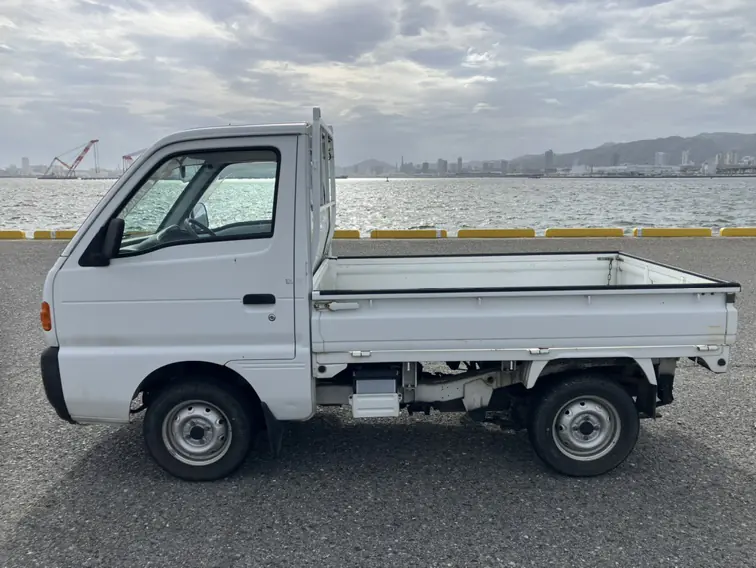
| 9th gen | Sept 1991-Jan 1999 | DC51T (2WD), DD51T (4WD); factory dumps DC51B, DD51B | F6A carbureted, 42 PS; 60 PS turbo on the 1997-1999 KU Turbo | Short 1,855 mm wheelbase; 3-speed automatic on some 2WD trucks from 1993 | Yes, all |
| 10th gen, F6A | Jan 1999-Sept 2001 | DA52T (2WD), DB52T (4WD) | F6A: carbureted 42 PS (2WD), fuel-injected 50 PS (4WD), turbo 56 PS until May 2000 | Larger body, front wheels ahead of the seats | Yes, all |
| 10th gen, K6A | Sept 2001-May 2002 | DA62T | K6A 658 cc twin-cam | Same body, new chain-driven engine | Builds through Oct 2001 now; the rest by mid-2027 |
| 10th gen, K6A | May 2002-2013 | DA63T | K6A | Updated DA62T | Month by month from May 2027 |
| 10th gen full cab | Nov 2005-Aug 2013 | DA65T | K6A, 48 PS | Short-wheelbase farm truck, 5-speed only | From Nov 2030 |
| 11th gen | Sept 2013-today | DA16T | R06A | Current truck | From Sept 2038 |
Two details catch buyers out.
A "2001 Carry" can be either engine. Suzuki moved every Carry to the K6A on September 4, 2001, so a 2001 truck may be an F6A-powered DA52T or DB52T, or an early DA62T with the K6A. The chassis code on the export certificate settles it.
The 1999 redesign changed the truck's shape. Japan enlarged the Kei class size limits in October 1998, and Suzuki used the room. The 1999 Carry measures 3,395 mm long and 1,475 mm wide against 3,295 mm and 1,395 mm for the 1991 truck, and its bed grew from 1,330 mm to 1,410 mm wide. Suzuki also moved the front wheels ahead of the seats, stretching the wheelbase from 1,855 mm to 2,350 mm. The longer truck rides better. The older one turns tighter, with a 3.8 m minimum turning radius against 4.1 m.
Check your state's rules in the state-by-state Kei Truck laws before you shop. The import paperwork is the same for every generation: see how to import a Kei Truck.
F6A or K6A: which engine is in your Carry?
Every Carry built before September 2001 has the F6A, a 657 cc three-cylinder with a timing belt. The K6A that replaced it is a 658 cc twin-cam three-cylinder, and it was the first Suzuki car engine to drive its camshafts with a chain.
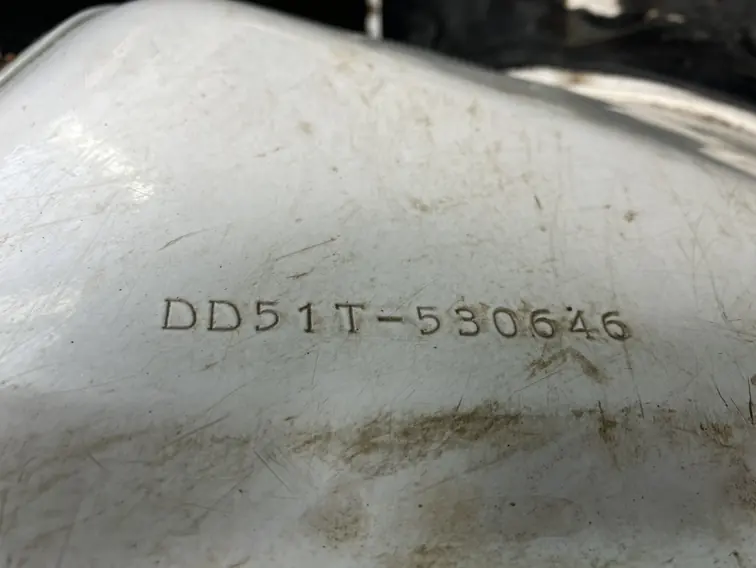
That difference sets your maintenance plan. The F6A needs a new belt on a schedule, and an old belt is the most likely thing to leave you stranded. The K6A has no belt to change, though an aging chain and tensioner can start to rattle. Confirm the engine model before ordering anything; it is printed on the Japanese export certificate and stamped on the block.
Within the F6A years, the fuel system varies:
- 1991-1999 DC51T and DD51T trucks are carbureted, except the 1997-1999 KU Turbo, which is fuel injected.
- At the January 1999 launch, Suzuki kept a carburetor on the 2WD DA52T and gave the 4WD DB52T fuel injection, worth 50 PS against 42 PS.
Suzuki added a 3-speed automatic to the 2WD DC51T in 1993. On the 1999-2001 trucks, the automatic arrived first with the turbo engine, including a 4WD automatic without low range, and spread to more grades from November 1999. Manuals far outnumber automatics, so plan on a longer search if you need two pedals.
What should you check before buying a Suzuki Carry?
Start with the chassis code and build month, because together they decide whether the truck clears the October 2001 cutoff, which engine it has and which parts fit. Then work through the truck itself:
- 4WD gearing. On 1990s 4WD trucks with a 5-speed, look for the EL (extra-low) position on the shift pattern. The 4-speed farm trucks use a two-speed transfer with a separate high/low lever instead, and 1999-2001 4WD manuals also have high and low range. Engage 4WD and low range on gravel and listen for grinding or clicking.
- Diff lock claims. Suzuki fitted rear diff locks to some 4WD trucks from 1986 and to farm-spec trucks from late 2005, but its 1991 and 1999 specification sheets do not list one. If a 1990s truck is sold with a diff lock, ask to see the control and test it.
- Rust. Check the frame rails around the leaf-spring hangers, the cab corners and door bottoms, the floor under the mats, and the bed floor, gate hinges and rear crossmember. Surface rust is normal on a farm truck. Rot through the frame is a reason to pass.
- Timing belt history. Ask for a date or mileage for the last belt change. With no record, budget the job for arrival.
- Fluids and leaks. Look for dried coolant around the hoses and radiator, check the fluid on an automatic, and on turbo trucks look for blue smoke or oil around the turbo.
- Dump beds. On factory dumps, raise and lower the bed, loaded if you can, and check the ram and hoses for leaks.
- Tires. Stock size on most trucks is 145R12 6PR LT. Japanese-market tires may lack the DOT code that some state inspections look for.
Read the auction sheet before you bid, and use the inspection list in the Kei Truck buying guide on any truck you can see in person.
What are the most common Suzuki Carry problems?
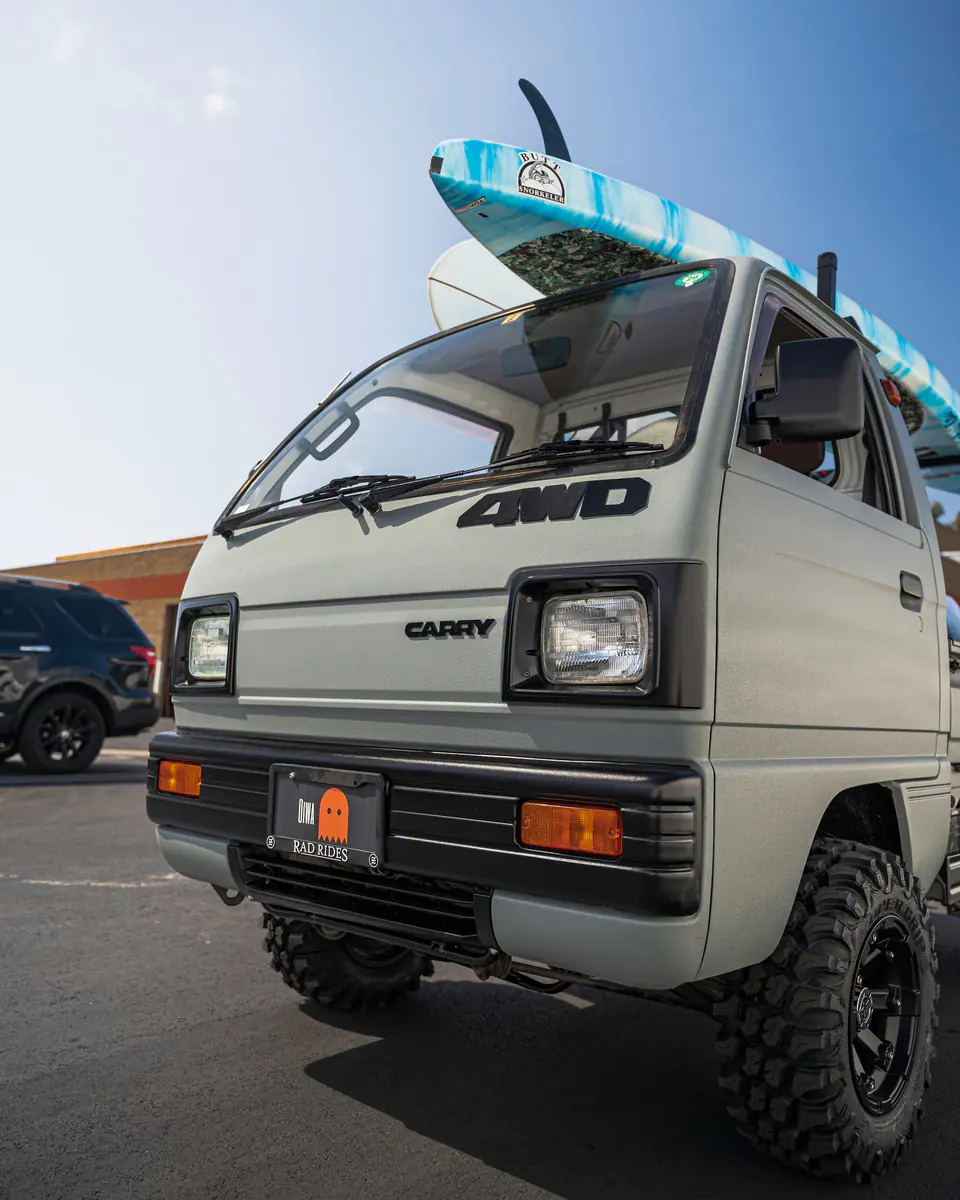
Most Carry problems at 25-plus years come from age, not design: rubber parts, ignition wear, fuel systems that sat, and rust.
Timing belt and seals
The F6A runs its camshaft on a rubber belt. A common rule of thumb is to replace it every 100,000 km (about 62,000 miles) or 10 years, whichever comes first, and to treat an undocumented belt as due. Fit a new tensioner and new cam and crank seals at the same time. Many owners add the water pump while the covers are off.
Carburetor and ignition
Carbureted trucks that sat for months tend to start hard, hunt at idle or stall when warm. A clean-out or a rebuild with Kei Truck carburetor parts usually sorts it. Misfires on high-mileage engines often trace back to the plugs, plug wires, or the cap and rotor in the distributor.
Clutch and gearbox
Hard-worked farm trucks wear clutches and second- and third-gear synchros. Check both on the test drive.
CV boots on 4WD trucks
4WD Carrys drive the front wheels through CV joints. A split boot throws grease and lets grit in. A boot costs far less than a joint, so look at them at every oil change.
Rust
Rust ends more Carry trucks than any mechanical fault. The maintenance guide covers prevention and service intervals.
Where do you get Suzuki Carry parts?
Order Carry parts by chassis code first (DC51T, DA52T and so on) and engine code second. A DD51T and a DB52T share the F6A, but bodies, brakes and many suspension parts changed with the 1999 redesign.
Oiwa Garage, the parts store that publishes this guide, sorts Carry parts by chassis code:
- DC51T and DD51T parts for 1991-1999 trucks
- DA52T and DB52T parts for 1999-2001 trucks
- DA62T parts for the first K6A trucks
- DA63T parts for the trucks that start turning 25 in 2027
Scrum owners can shop the same lists by matching their truck to the Carry code. For the first service on a newly imported truck, plan on oil and filter, air and fuel filters, spark plugs, coolant, gear oil, and the timing belt on F6A engines.
How does the Carry compare with other Kei Trucks?
The Carry uses the conventional Kei Truck layout: engine under the cab and a leaf-sprung live rear axle. The Mitsubishi Minicab and the Daihatsu Hijet follow the same basic recipe. The Honda Acty mounts its engine between the axles for better balance, and the Subaru Sambar puts a four-cylinder at the back with independent suspension at every wheel.
Pick a Carry if you want a simple truck with easy parts support and 4WD with real low gearing. Look at the others if ride, cab room or a specific body matters more. The Kei Truck model comparison lines up all five.
Find parts for your truck
Pick your model and chassis code. We'll send you to the right Oiwa Garage collection.
Frequently asked questions
Is a Mazda Scrum the same truck as a Suzuki Carry?
Yes. Mazda sold the Carry as the Scrum, under its Autozam brand from 1989 to 1995 and as a Mazda after that. The Scrum wears Mazda chassis codes, such as DK51T on a 1990s 4WD or DG52T and DH52T on 1999-2001 trucks, but it shares the Carry's engine, gearbox and most service parts. Give your parts supplier the matching Carry code.
Does the Suzuki Carry have a timing belt or a timing chain?
It depends on the engine. The F6A in every Carry built before September 2001 uses a timing belt that needs periodic replacement. The K6A that arrived with the DA62T in September 2001, and stayed in the DA63T and DA65T, uses a timing chain. Check the engine model on the export certificate or the block before you order parts.
Can I import a 2001 Suzuki Carry?
Yes, if it was manufactured in October 2001 or earlier, as of October 2026. A 2001 Carry can be a DA52T or DB52T with the F6A, or an early DA62T with the K6A, which went on sale in September 2001. Trucks built after October 2001 become eligible one month at a time as they reach 25 years from their build month.
Did the Suzuki Carry come with an automatic transmission?
Some did. Suzuki offered a 3-speed automatic on 2WD DC51T trucks from 1993. On the 1999-2001 DA52T and DB52T it came first with the turbo engine, then on more grades from November 1999. The 4WD automatic has no low range. Most Carry trucks left the factory with 4-speed or 5-speed manuals, so automatics take longer to find.
What is the difference between a DC51T and a DD51T?
Drive layout. Suzuki used paired codes to separate 2WD and 4WD trucks, so the DC51T is the 2WD truck and the DD51T is the 4WD truck of the 1991-1999 generation. The 1999-2001 trucks follow the same pattern, with DA52T for 2WD and DB52T for 4WD. From the DA62T on, one code covers both drive types.
Does the Suzuki Carry have a rear diff lock?
Some do. Suzuki added a rear diff lock to some 4WD trucks in 1986, to the 4WD full-cab farm Carry from November 2005, and to farm-spec 4WD manuals in the current DA16T range. Suzuki's 1991 and 1999 specification sheets do not list one for the trucks most often imported, so see the control working before you pay extra for it.
Sources
- 49 U.S.C. 30112: Prohibitions on noncomplying motor vehicles, including the 25-year exception in (b)(9) (Cornell LII)
- 49 CFR 591.5: Declarations required for importation, including the 25-year declaration in (i) (Cornell LII)
- U.S. Customs and Border Protection: Importing a Motor Vehicle
- r/KeiTruckBuilds owner community