On this page
Key facts
- Maker
- Suzuki
- Years sold in Japan
- As the Every since March 1985. Every Wagon since June 1999
- US-importable now (as of Nov 2026)
- Vans built November 2001 or earlier are past the federal 25-year mark. This covers DA52V/DB52V vans and all earlier Every vans. The first DA62V vans also qualify
- Chassis codes since 1991
- DE51V (2WD), DF51V (4WD): 1991 to 1999. DA52V (2WD), DB52V (4WD): 1999 to 2001. DA62V, DA64V, DA17V: either drive
- Engine(s)
- F5A (1985 to 1989); F6A, 657 cc, timing belt (1990 to September 2001); K6A, 658 cc, timing chain (2001 to 2015); R06A, 658 cc (2015 on)
- Layout and drive
- Engine between the axles on DE51V/DF51V; under the driver's seat from the 1999 redesign; rear-wheel drive or 4WD
- 4WD system
- January 1999 redesign: part-time on every 4WD van. Turbo vans: full-time from November 1999; part-time since February 2024. DF51V: full-time per Suzuki; the work grades may be part-time
- Sold by other makers as
- Mazda Scrum (from 1989); Nissan NV100 Clipper, now Clipper Van (December 2013 on); Mitsubishi Minicab Van (February 2014 on)
What is the Suzuki Every?
The Suzuki Every is Suzuki's Kei Van. The Every is the cargo version, classed in Japan as a Kei commercial vehicle. The Suzuki Every Wagon is the passenger version. It has been on sale since June 17, 1999[1].
The Every grew out of the Suzuki Carry Van. Suzuki launched the Suzulight Carry Van in September 1964. In November 1982, the Every name appeared on the Carry Van's passenger-style grade. In March 1985, Every became the model name[2]. Work grades of the 1991 van were sold as the Carry Van until November 1993[3].
Which Suzuki Every generations can you import?
As of November 2026, a Suzuki Every van built in November 2001 or earlier is at least 25 years old. At that age, federal law lets a vehicle in without meeting US safety standards[4]. The 25-year rule counts from the date of manufacture. The build date determines when the van qualifies.
The generation numbers are Suzuki's, counted from the 1964 Carry Van. Other references call the 1991 van the 3rd generation, so search by chassis code.
| Generation | Years | Chassis codes | Engine | Notes | US-importable (Nov 2026)? |
|---|---|---|---|---|---|
8th gen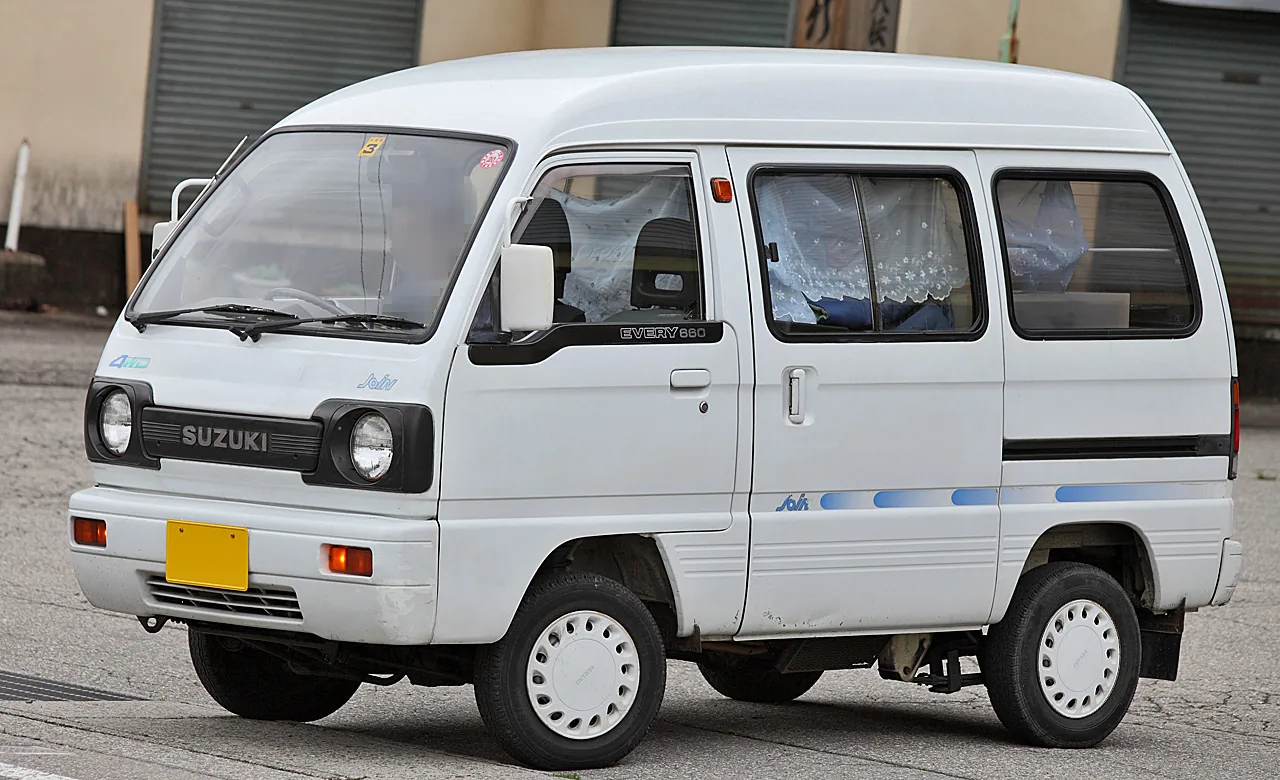 | Mar 1985-Sept 1991 | DA71V/DB71V, DA41V/DB41V, DA51V/DB51V[3] | F5A to May 1989; F6A, 657 cc, from Mar 1990 | First van named Every | Importable now |
9th gen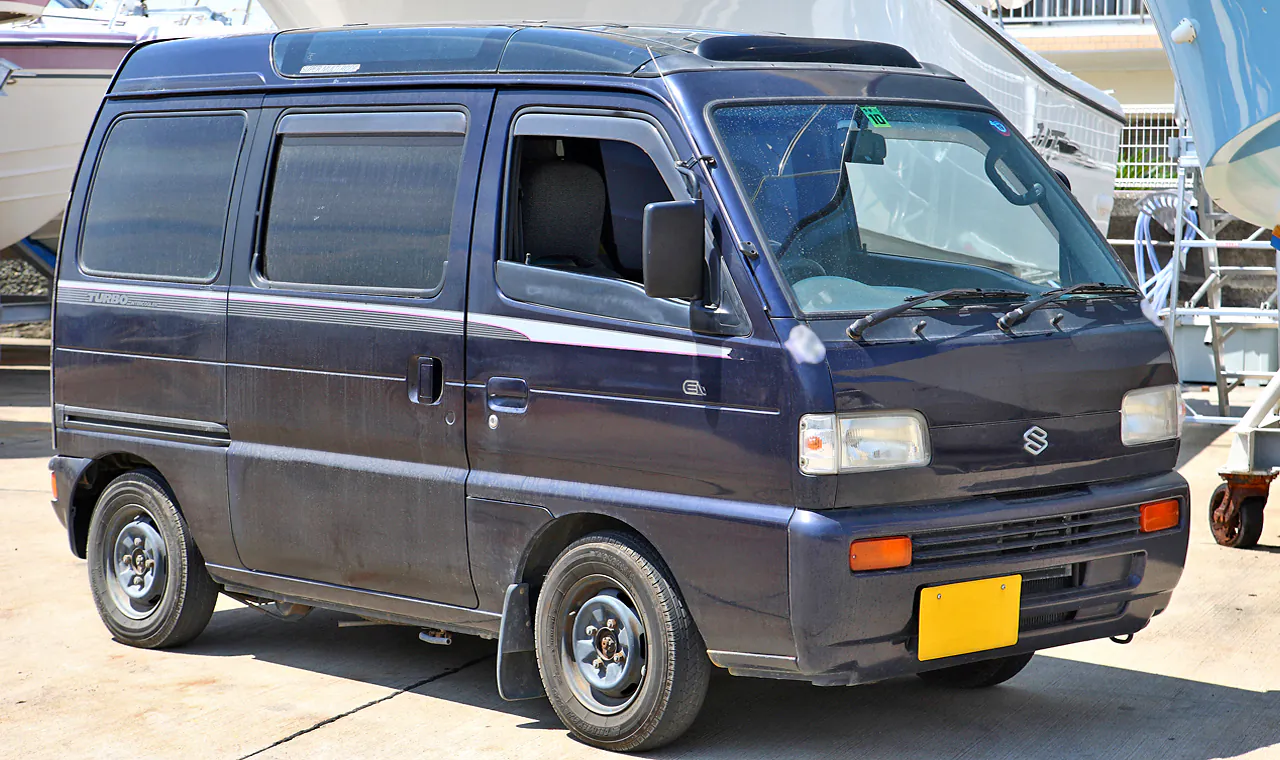 | Sept 1991-Jan 1999 | DE51V (2WD), DF51V (4WD) | F6A, 657 cc: 42 or 50 PS; turbo 61 PS, 64 PS from May 1995 | Engine between the axles | Importable now |
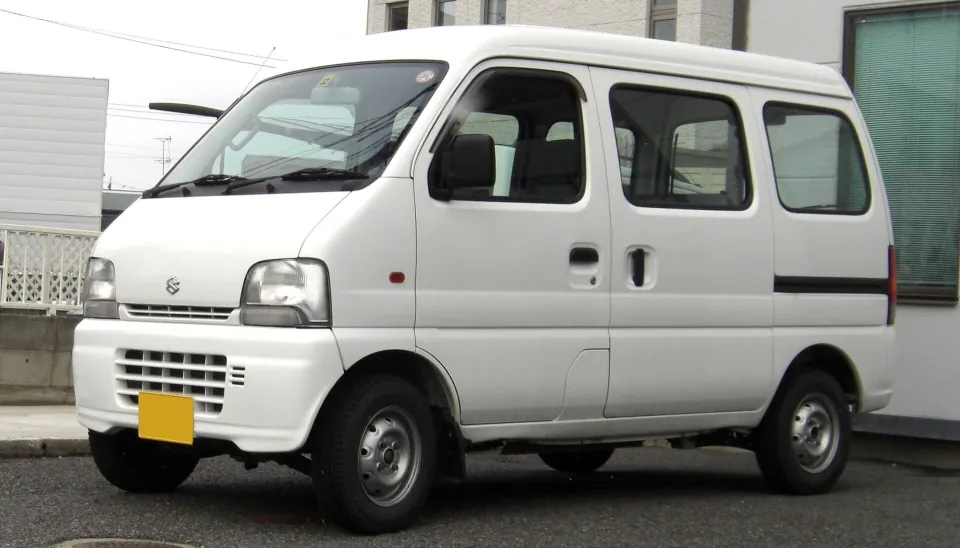
10th gen, F6A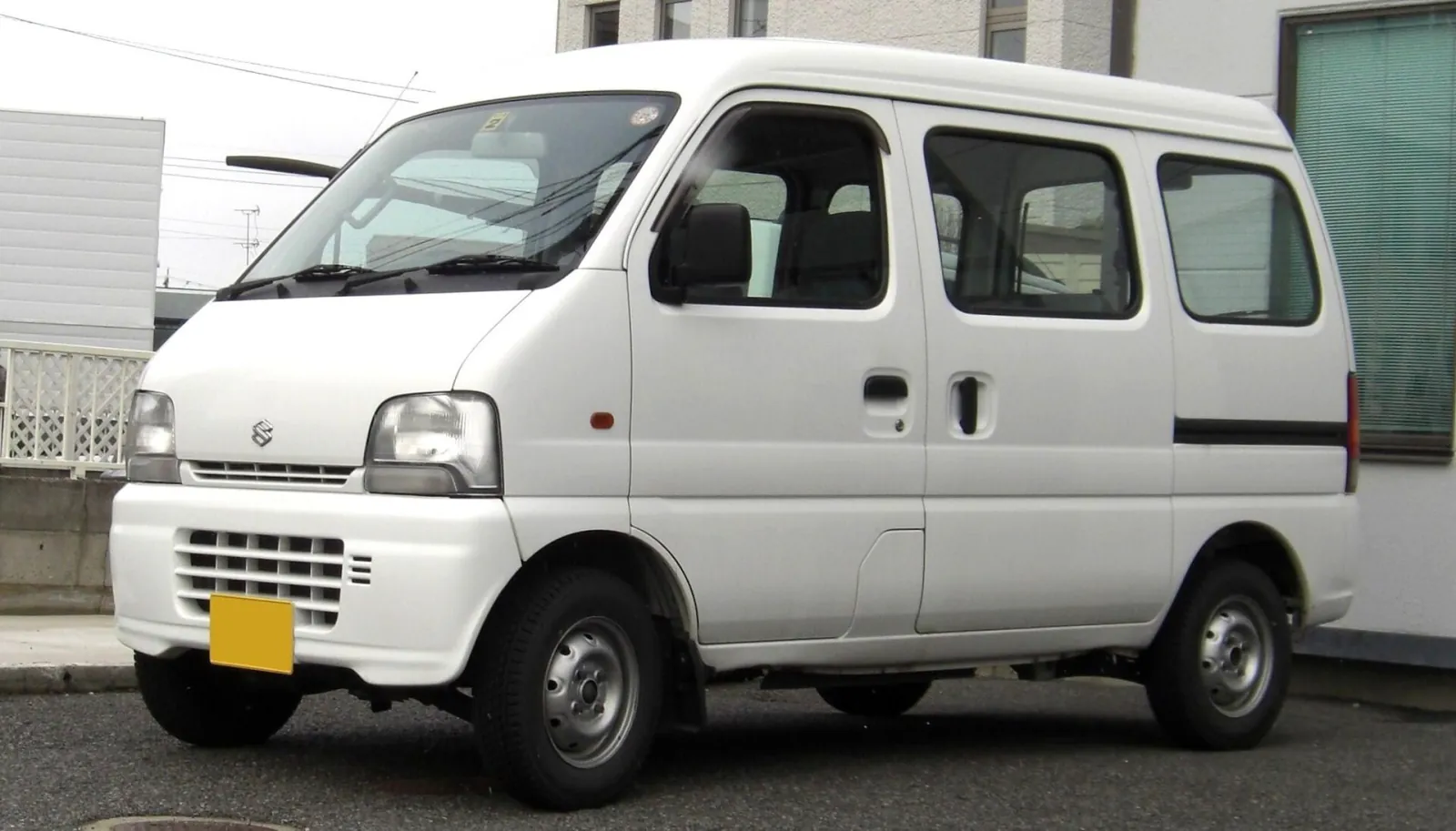 | Jan 1999-Sept 2001 | DA52V (2WD), DB52V (4WD); wagon DA52W, either drive | F6A: 50 PS; turbo 60 PS, 64 PS from Nov 1999 | Larger body; engine under the driver's seat; Every Wagon from June 1999 | Importable now |
| 10th gen, K6A | Sept 2001-Aug 2005 | DA62V, either drive; wagon DA62W | K6A, 658 cc twin-cam: 49 PS; turbo 64 PS | Same body, new engine; all qualify by Aug 2030 | Built by Nov 2001 |
11th gen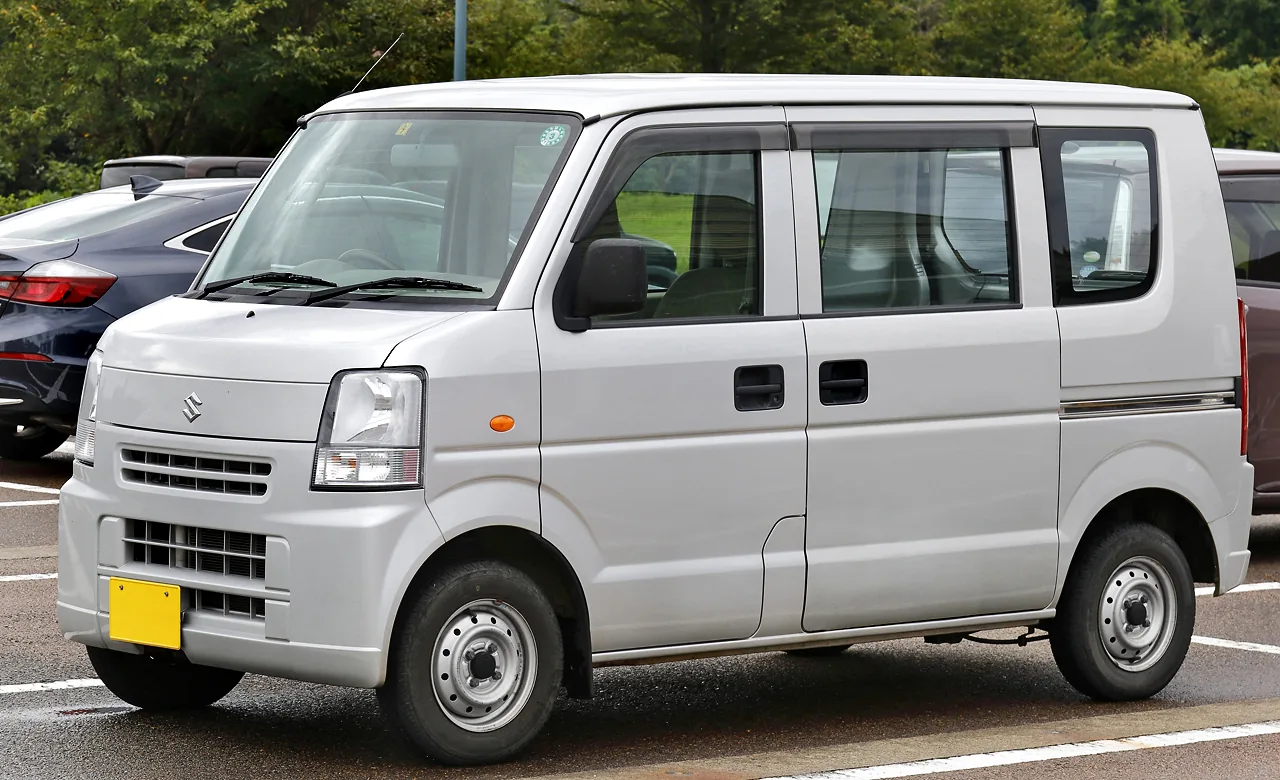 | Aug 2005-Feb 2015 | DA64V, either drive; wagon DA64W | K6A: 49 PS; turbo 64 PS | Full redesign; Nissan twin from Dec 2013, Mitsubishi twin from Feb 2014 | From Aug 2030 |
12th gen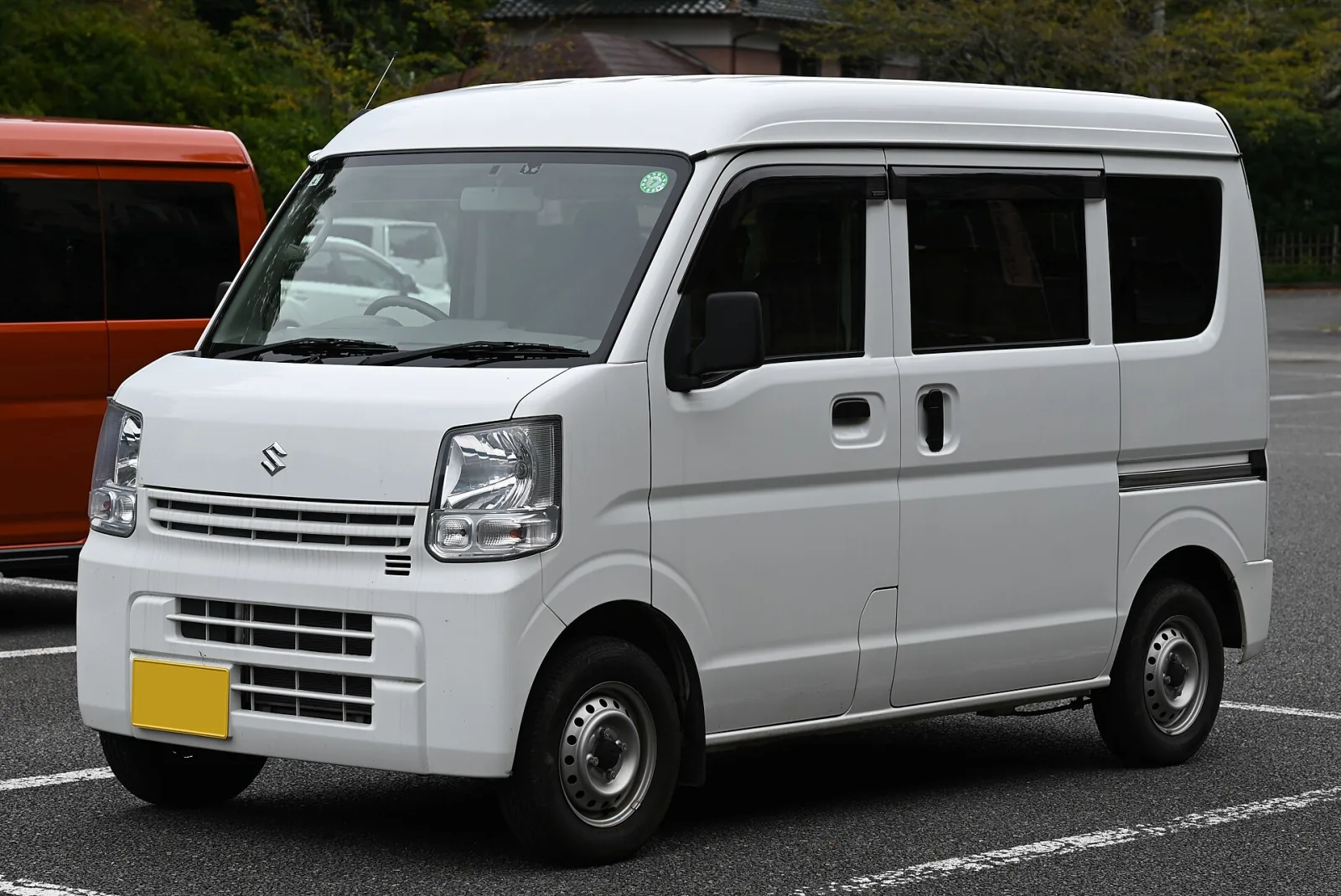 | Feb 2015-today | DA17V, either drive; wagon DA17W | R06A: 49 PS; turbo 64 PS | Current van; from the May 2026 update, catalogs give its code as DA18V (wagon DA18W) | From Feb 2040 |
PS is metric horsepower.
Photo credits. 8th gen: Tennen-Gas, CC BY-SA 3.0. 9th gen: Tennen-Gas, CC BY-SA 3.0. 10th gen: TTTNIS, public domain. 11th gen: Tennen-Gas (天然ガス), CC BY-SA 4.0. 12th gen: TTTNIS, CC0.
All DE51V, DF51V, DA52V, DB52V and DA52W vans are now past 25. The DA62V went on sale on September 4, 2001[5]. Vans built through November 2001 qualify today. A DA62V built in March 2003 turns 25 in March 2028. A 2001 Every can have either the F6A or the K6A. A DA52V or DB52V has the F6A. A DA62V has the K6A. Read the build month on the van itself.
Before you buy, read the import guide and your state's Kei Truck laws. To see a Suzuki Every for sale, browse Kei Vans for sale.
Suzuki Every A/C, transmissions and 4WD
Air conditioning, automatic transmissions and 4WD were offered. Not every van had all three.
Air conditioning
The Every switched to R134a refrigerant in November 1993[3]. At the January 1999 redesign, Suzuki made air conditioning standard on all high-roof Every vans[6]. The GA was the only standard-roof van at that launch. On an older van or a GA, confirm that air conditioning is fitted.
Manual or automatic
DE51V and DF51V vans came with a 4-speed manual, a 5-speed manual or a 3-speed automatic. The January 1999 van offered a 5-speed manual or a 3-speed automatic. On November 25, 1999, turbo automatics changed to four speeds[7]. Non-turbo automatics still had three speeds.
2WD or 4WD
DE51V and DA52V are 2WD. DF51V and DB52V are 4WD. A 2WD Every drives the rear wheels. From the DA62V onward, the chassis code does not distinguish 2WD from 4WD.
Suzuki said all 4WD Every vans of 1991 were full-time[2]. The work grades may have part-time 4WD instead. Check the van you are buying. The January 1999 van had part-time 4WD. You could switch it with a button while the van was moving[6]. On November 25, 1999, turbo vans changed to full-time 4WD. The GA, PA and Join stayed part-time[7]. The DA62V kept that split.
Which other vans are a Suzuki Every underneath?
Three other vans are a Suzuki Every underneath: the Mazda Scrum van since 1989, the Nissan Clipper Van since December 2013 and the Mitsubishi Minicab Van since February 2014. Suzuki builds all three. Earlier Clipper Vans and Minicab Vans were built by Mitsubishi. The electric Minicab is not an Every. Nissan sold its Suzuki-built van as the NV100 Clipper until March 2024.
Nissan Clipper Van, NV100 Clipper and Clipper Rio
The Nissan Clipper Van has come from two makers. From October 6, 2003, Mitsubishi built it as a twin of the Minicab Van (U71V for 2WD, U72V for 4WD). Nissan renamed it NV100 Clipper on January 25, 2012. On December 3, 2013, a new Nissan NV100 Clipper went on sale, supplied by Suzuki[8]. That version was a Suzuki Every DA64V with Nissan's DR64V chassis code. On March 3, 2015, the NV100 Clipper switched to the current Every model. Nissan used the DR17V chassis code. Nissan renamed it Clipper Van on March 26, 2024.
The Clipper Rio is the passenger version. From June 2007 to January 2012 it was a Mitsubishi Town Box twin (U71W, U72W). Since December 2013 it has been an Every Wagon (DR64W, then DR17W).
No Clipper Van is 25 years old yet. The first Mitsubishi-built vans turn 25 in September or October 2028. The first Suzuki-built vans turn 25 around December 2038. The Nissan Clipper guide covers the Clipper truck.
Mitsubishi Minicab Van and Town Box
Since February 2014, the Mitsubishi Minicab Van has been a Suzuki Every. The one exception is the electric Minicab[9]. The Minicab Van used chassis code DS64V until March 2015, then DS17V. The Town Box is Mitsubishi's version of the Every Wagon. The first Suzuki-built vans turn 25 in February 2039.
Mazda Scrum van
The Mazda Scrum van is a Suzuki Every sold by Mazda. It launched in 1989[10]. Each generation of Scrum van keeps the Every's grille and bumper[10].
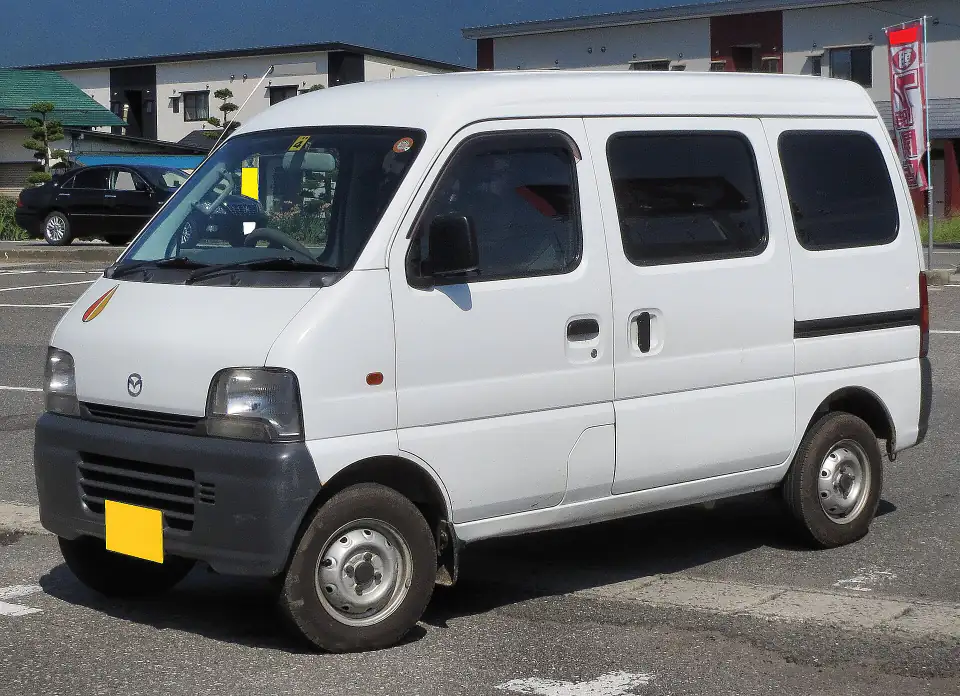
The Scrum uses different chassis codes for the same drive types as the Every. The 2WD Mazda Scrum DL51V is the Suzuki Every DE51V. The 4WD Scrum DM51V is the Every DF51V. The 2WD Scrum DG52V is the Every DA52V. The 4WD Scrum DH52V is the Every DB52V. Later Scrum vans are DG62V, DG64V and DG17V. All DL51V, DM51V, DG52V and DH52V vans are now past 25.
How do you tell a Nissan Clipper Van from a Suzuki Every?
Read the chassis code. A Suzuki-built Clipper Van has chassis code DR64V or DR17V. The matching Every has chassis code DA64V or DA17V.
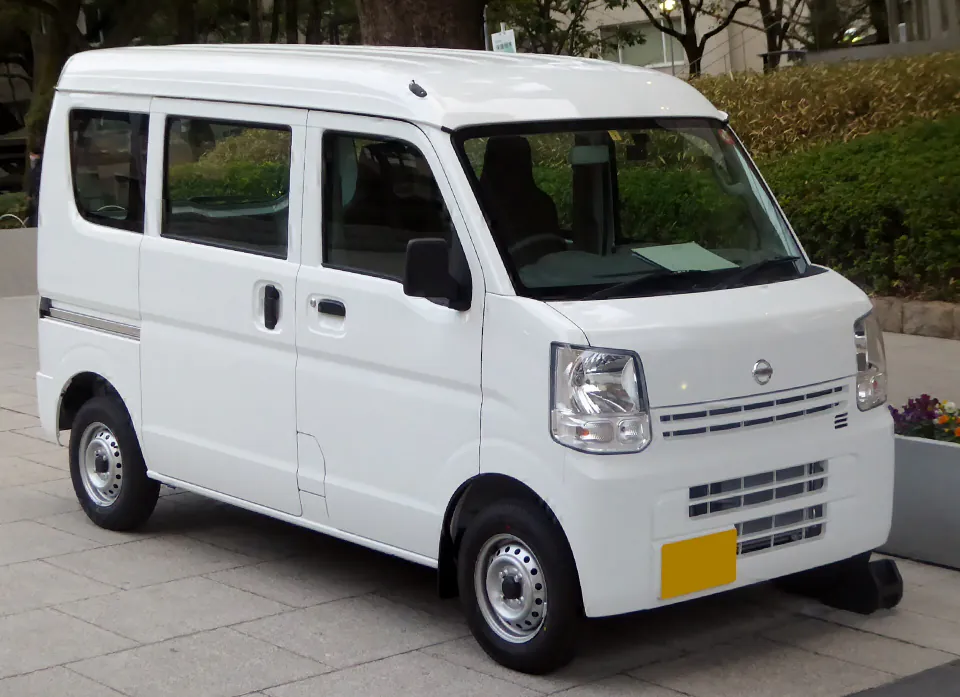
The DR64V Clipper's only exterior differences from the Every are its emblems[11]. Later Clipper Vans carry Nissan's current logo on the nose, tail and steering wheel. Their decal at the lower left rear reads CLIPPER[11].
Is the Suzuki Every Plus or Every Landy a Kei Van?
No. The Every Plus has a 1,298 cc engine. The Kei limit is 660 cc. Suzuki launched the Every Plus (chassis code DA32W) on June 17, 1999[12]. It was Suzuki's first seven-seater. It is based on the Every, but it measures 3,675 mm long by 1,505 mm wide. The Kei limits are 3.40 m by 1.48 m. All have a 4-speed automatic. On May 24, 2001, Suzuki renamed it the Every Landy. It was sold until 2005. All Every Plus vans are now past 25.
What should you check before buying a Suzuki Every?
Start with the chassis code and the build month.
- Timing belt. The F6A in DE51V, DF51V, DA52V and DB52V vans drives its camshaft with a timing belt[13]. Ask when it was last changed.
- Turbo exhaust recall. Suzuki recalled turbo DA62V and DA62W vans built from August 28, 2001 to June 17, 2002[14]. The exhaust pipe can crack at a bracket weld.
- 4WD recall. In April 2007, Suzuki recalled 4WD DA62V vans[15]. The rear propeller shaft bearing can overheat on long high-speed runs.
- Wheels. The DE51V and DF51V changed from a 114.3 mm wheel bolt circle to 100 mm in May 1995[3]. Measure before you order wheels.
- Rust. The Kei Van guide lists where to look on any Kei Van. Suzuki widened its use of rust-resistant steel on November 25, 1999[7].
Use the Kei Truck buying guide for the full inspection.
Can you use Suzuki Carry parts on a Suzuki Every?
The Every and the Carry truck shared an engine family from September 1991 to September 2013[16]. Both ran the F6A, with its timing belt, until September 2001. Both changed to the chain-driven K6A that month[17]. The matching Carry codes are DC51T/DD51T, DA52T/DB52T, then DA62T, DA63T and DA65T. In September 2013, the Carry moved to the R06A. The Every kept the K6A until February 2015.
A shared engine family does not mean every part swaps. The DE51V and DF51V carry the engine between the axles. They have coil springs at the back[2]. The Carry truck from those years has its engine under the cab. It uses leaf springs[3]. The Carry had a minor change in May 2002. The Every's cabin stayed the same[3].
Many service parts for the F6A and the K6A fit either vehicle. Air filters do not. The Carry truck and the Every van take different sizes. We know this from selling parts for both at Oiwa Garage. Measure your old filter before you order. We list two heights for the DC51T/DD51T Carry alone: 5 inches and 6 3/8 inches. Check suspension parts and body parts against your Every's chassis code too: DE51V, DF51V, DA52V, DB52V or DA62V. The Suzuki Carry guide covers the truck.
Frequently asked questions
Is the Suzuki Every street legal in the US?
An Every that is at least 25 years old can be imported without meeting federal safety standards. The 25-year rule counts from the date of manufacture. Go by the build date. As of November 2026, that means an Every built in November 2001 or earlier. That is the federal import rule only. For state road rules, see the Kei Truck laws by state.
Is the Nissan Clipper Van a Suzuki Every?
Since December 3, 2013, yes. Suzuki supplies the van to Nissan. Its chassis code was DR64V, followed by DR17V from March 2015. From October 2003 to 2013, the Clipper Van was a twin of the Mitsubishi Minicab Van (U71V, U72V). No Clipper Van is 25 years old yet. The first ones turn 25 in September or October 2028.
What is the difference between the Suzuki Every and the Every Wagon?
The Every is the cargo van, classed in Japan as a Kei commercial vehicle. The Every Wagon is the passenger version, on sale since June 17, 1999. Wagon codes end in W, such as DA52W or DA62W. At its 1999 launch, all wagons had the turbo engine, two airbags and ABS. Its rear seat sat 90 mm further back than the van's.
Is the Mazda Scrum the same as a Suzuki Every?
Yes. The Mazda Scrum van is a Suzuki Every sold by Mazda. The Scrum launched in 1989[10]. The Scrum Wagon, added in December 1999, is the Every Wagon. The Scrum van's chassis codes were DL51V or DM51V from October 1991. They were DG52V or DH52V from January 1999, then DG62V.
Does the Suzuki Every have a timing belt or a timing chain?
It depends on the engine. The F6A in DE51V, DF51V, DA52V and DB52V vans uses a timing belt. The K6A uses a timing chain. Suzuki fitted the K6A from September 2001, first in the DA62V, then in the DA64V until February 2015. A 2001 Every can have either engine, so read the chassis code.
Was there a Suzuki Every turbo?
Yes. The 1991 Every offered an intercooled turbo F6A rated at 61 PS (metric horsepower), raised to 64 PS in May 1995. The 1999 van's turbo made 60 PS at launch, then 64 PS from November 25, 1999. From that date, turbo Every vans with 4WD used a full-time system. Since February 2024, the turbo van's 4WD has been part-time. The K6A turbo that followed in September 2001 is also rated at 64 PS.
Is the Suzuki Every Plus a Kei Van?
No. The Every Plus has a 1,298 cc engine, and the Kei limit is 660 cc. It is also longer and wider than the Kei limits allow, at 3,675 mm by 1,505 mm. Suzuki sold it from June 1999 with seven seats. In May 2001 it was renamed the Every Landy. It is based on the Every, so check the engine size on any van sold under that name.
Sources
- Suzuki: Every Wagon on sale June 17, 1999 (Japanese)
- Suzuki Digital Library: Carry Van and Every model history (Japanese)
- Japanese Wikipedia: Suzuki Every
- 49 U.S.C. 30112: Prohibitions on noncomplying motor vehicles, with the exception for vehicles at least 25 years old (Cornell LII)
- Suzuki: Every Wagon and Every with the K6A engine, on sale September 4, 2001 (Japanese)
- Suzuki: Carry and Every full model change, on sale January 6, 1999 (Japanese)
- Suzuki: Every update of November 25, 1999 (Japanese)
- Nissan: new NV100 Clipper and NV100 Clipper Rio, supplied by Suzuki, on sale December 3, 2013 (Japanese)
- Japanese Wikipedia: Mitsubishi Minicab
- Japanese Wikipedia: Mazda Scrum
- Japanese Wikipedia: Nissan Clipper Van
- Suzuki: Every Plus seven-seat wagon on sale June 17, 1999 (Japanese)
- Suzuki Digital Library: F-series engines, with timing belt drive (Japanese)
- Suzuki recall notice of July 10, 2003: exhaust pipe on turbo Every vans (Japanese)
- Suzuki recall notice of April 18, 2007: Carry and Every 4WD rear propeller shaft bearing (Japanese)
- Suzuki Digital Library: engines by model and year (Japanese)
- Suzuki Digital Library: K-series engines, with chain drive (Japanese)